How to Create Income While Living Your Best Life
Most of us were taught to work hard now and hope we have enough time, money, and energy to enjoy life later.
But what if we turned that idea around?
What if we began with the life we want to live—and then chose income streams that fit around it?
That does not mean money magically appears while we relax beside a swimming pool. Nearly every income stream requires learning, effort, patience, and consistency, especially in the beginning. The goal is not to avoid work. The goal is to create work that gives us more control over our time, location, and future.
If your “freedom business” makes you dread waking up every morning, you may not have created freedom. You may have simply built yourself a second job—with a more demanding boss named you.
Fortunately, there are more ways than ever to create income from your knowledge, interests, experiences, and even the things already sitting in your garage. Let’s look at several of the most practical options.
Start With the Life You Want
Before choosing an income opportunity, ask yourself a few honest questions:
Do I want to work primarily from home, or do I enjoy meeting people?
Would I rather create content, recommend products, sell physical items, or build a team?
Do I need income quickly, or can I build something that grows over time?
How many hours can I consistently give this each week?
Do I want to handle inventory, packing, shipping, and customer service?
What subjects, products, skills, or hobbies do I already understand?
There is no single “best” income model. There is only the model that best fits your abilities, personality, resources, and goals.
1. Affiliate Marketing: Recommend Without Creating the Product
Affiliate marketing is one of the simplest online business models to understand. You recommend another company’s product or service using a special tracked link. If someone makes a qualifying purchase through that link, you may earn a commission.
You do not normally create the product, stock inventory, process the payment, or ship the order. Your job is to help the right person discover the right solution.
Different styles of affiliate marketing
Review and comparison content
You review products, compare two or more choices, or explain the advantages and disadvantages of each. Honest comparisons build far more trust than declaring everything “amazing.”
Educational or solution-based content
Instead of leading with a sales pitch, you teach people how to solve a problem. A sewing-machine repair video might naturally include links to the needles, tools, oil, or replacement parts used in the demonstration.
Niche websites and blogs
A focused website can answer questions for a specific audience—such as people interested in healthy living after 50, CNC woodworking, sewing, pets, travel, or small business—and recommend useful products within that subject.
Social media affiliate marketing
Short videos, demonstrations, stories, and posts can introduce products to an audience. Social media can produce faster feedback, but your results depend heavily on the quality of your content and the trust you build.
Email and community-based marketing
An email list or online community lets you stay connected without depending entirely on a social platform’s algorithm. The strongest emails educate, entertain, or help first—and promote selectively.
Recurring-commission programs
Some programs pay only once. Others may pay recurring commissions while a referred customer remains subscribed. Recurring income can become more predictable, but only when the product continues to provide enough value for customers to stay.
Amazon Associates: a free place to begin
Amazon Associates is Amazon’s affiliate program. It is free to join, and it lets approved creators recommend millions of eligible products using tracked links. Amazon reviews new applications after the applicant generates at least three qualifying sales within the first 180 days. Amazon also expects an applicant’s website or approved social channel to contain useful, original, publicly available content. Review Amazon’s current application requirements before applying.
Amazon Associates can be a natural fit for tutorials, gift guides, equipment lists, product comparisons, and “what I use” pages. The commissions on many products are modest, so it usually works best as one part of a larger content strategy rather than the entire business.
Amazon also requires a clear disclosure, including the statement: “As an Amazon Associate I earn from qualifying purchases.”
Free to join does not mean effortless income. You still need helpful content, qualified traffic, honest recommendations, and consistency.
2. Multi-Level Marketing and Network Marketing
Multi-level marketing, also called network marketing, combines product sales with the opportunity to earn additional compensation based on the sales activity of a team or organization.
It is different from traditional affiliate marketing. An affiliate normally earns from personal referrals. A network marketer may earn from retail customers, personally enrolled members or distributors, and—in accordance with the company’s compensation plan—sales activity within multiple levels of a team.
Different ways to build a network-marketing business
Product-first or retail-customer approach
You concentrate on finding customers who genuinely want the products, whether or not they have any interest in the business opportunity.
Relationship and community approach
You build a group around a shared interest—health, fitness, beauty, personal development, or another lifestyle—and create ongoing education and support.
Team-building and leadership approach
You help other people learn how to find customers, communicate responsibly, and build their own businesses. This requires training and leadership, not simply signing people up and wishing them luck.
Content or attraction-marketing approach
Blogs, videos, educational posts, and email content attract people who are already interested in the subject. This is generally more sustainable than repeatedly sending unsolicited messages to friends and strangers.
Local and online hybrid approach
Some people prefer face-to-face conversations, local events, samples, or small group meetings while also using online content to reach a broader audience.
LiveGood as one example
One program I personally use and share is LiveGood, a health-and-wellness membership and affiliate program.
LiveGood separates the customer membership from the affiliate opportunity. Members currently pay $9.95 monthly or $99.95 annually for access to member pricing on the company’s wellness products. Affiliates can participate in the company’s compensation plan, which includes retail commissions and other commission categories described in its official compensation plan. A person can be a member, an affiliate, both, or a retail customer. You can review those distinctions in the LiveGood FAQ.
What appeals to me about this type of model is the ability to combine products people can use with the possibility of recurring income. However, LiveGood—or any other network-marketing program—is not guaranteed income. Results depend on customers, sales, communication skills, consistent effort, and many other factors.
Before joining any MLM, study the products, costs, refund policy, compensation plan, and income disclosure information. Be cautious of pressure, required inventory purchases, or anyone promising fast riches. The Federal Trade Commission advises consumers to look for genuine retail demand and to carefully evaluate earnings claims and business expenses.
3. YouTube and Rumble: Turn Knowledge Into a Digital Asset
Video can take longer to build than reselling an item, but it has one enormous advantage: a helpful video can continue working after the day it was created.
You can build a channel around almost anything you genuinely understand or enjoy:
Tutorials and repair demonstrations
Product reviews and comparisons
Health and lifestyle discussions
Hobby, crafting, sewing, or CNC projects
Business lessons and personal experiences
Entertainment, commentary, or local information
Ways a video channel can create income
Platform advertising or creator revenue
Channel memberships, tips, or viewer support
Affiliate links in video descriptions
Sponsored content and brand partnerships
Leads for your services or local business
Sales of physical products, guides, courses, or downloads
Referrals to an affiliate or network-marketing program
YouTube’s Partner Program offers several monetization features, each with its own eligibility requirements. You do not have to wait for advertising eligibility to use a channel to attract customers, generate leads, or recommend products with properly disclosed affiliate links.
Rumble gives creators another place to distribute video. Depending on the selected license and current eligibility, creators may be able to earn through video monetization, licensing, tips, or Rumble’s Creator Program. Rumble allows creators to publish videos that are also on YouTube, but the licensing choice matters, so read the current licensing explanation before uploading.
The smartest approach may be to create one strong video and then adapt it into several assets: a YouTube video, a Rumble upload, short social clips, a blog post, an email, and several affiliate-friendly product recommendations. One idea can work in several places without requiring you to reinvent the wheel every morning.
4. Social Media: Build Attention and Direct It Somewhere Useful
Facebook, Instagram, TikTok, Pinterest, LinkedIn, and other social platforms can help you reach people without owning a television station or buying a newspaper ad.
But attention alone is not a business. Thousands of views feel exciting, but views do not pay the electric bill unless they lead to something useful.
Social media can support income through:
Affiliate recommendations
Sponsored posts or user-generated content for brands
Live product demonstrations or selling
Leads for local services
Traffic to a blog, YouTube channel, or email list
Sales of handmade, used, or digital products
Invitations to a membership, community, or business program
Choose one main subject and one primary platform at first. Create content that answers questions, demonstrates something, shares a useful experience, or makes people smile. Then give the reader or viewer a simple next step.
If you receive commissions, free products, discounts, or other benefits, clearly disclose the relationship near the recommendation. The FTC’s disclosure guidance applies to social posts, videos, livestreams, blogs, and other promotional content.
5. Buying and Selling: Turn Products Into Profit
Reselling can be one of the fastest ways to create extra cash because you can begin with things you already own.
Walk through your closets, garage, spare room, or workshop. That lamp you have not used since 2014 may not be clutter—it may be inventory waiting for better lighting and a decent photograph.
After selling unused belongings, some people begin buying underpriced items at yard sales, estate sales, thrift stores, auctions, liquidation sales, or local listings and reselling them for a profit. Others repair, restore, personalize, or create products before selling them.
Choosing a selling platform
Facebook Marketplace is especially useful for local sales, large items, tools, furniture, appliances, machinery, and products people want to inspect in person.
OfferUp is now focused on local transactions; the platform ended nationwide shipping in September 2025. It can be useful when you want to reach buyers in your community without packing and mailing the item.
5miles supports local buying and selling and also offers shipping on some eligible listings. It may give an item additional exposure in areas where the app has an active audience.
Mercari is designed around shipped consumer goods and can work well for clothing, electronics, collectibles, household items, and other products that are easy to pack. Review its current selling and shipping fees before pricing.
eBay gives sellers access to a large audience and supports both fixed-price and auction-style listings. It is often useful for collectibles, replacement parts, vintage items, specialized tools, and products that may be difficult to sell locally. Fees vary by category and selling plan.
Amazon selling is different from Amazon Associates. Amazon Associates lets you recommend someone else’s products for a potential commission and is free to join. Selling on Amazon means you are the seller and are responsible for inventory and fees. You may fulfill orders yourself through Fulfilled by Merchant (FBM) or use Fulfillment by Amazon (FBA), which can handle storage, packing, shipping, returns, and customer service for additional fees. Review Amazon’s current seller pricing before buying inventory.
You can also explore specialty platforms such as Etsy for handmade or designed products, Poshmark for fashion, or niche groups and forums for specialized equipment.
Always calculate the complete cost before buying something to resell:
Expected selling price − purchase cost − platform fees − shipping − packaging − returns − advertising = potential profit
A busy sales account can still lose money if the numbers do not work.
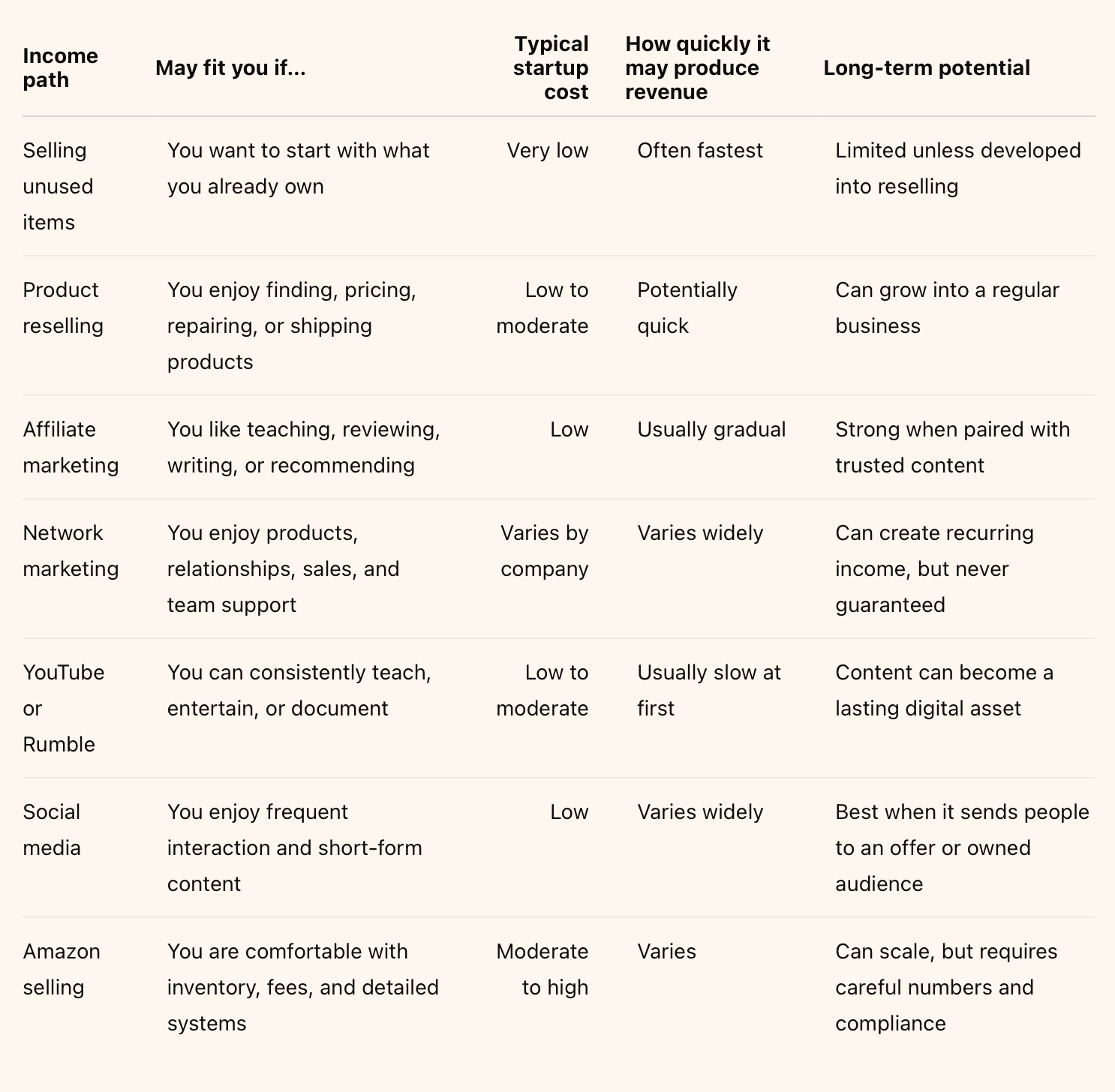
Which Income Style Fits You Best?
The Real Opportunity Is in Combining Income Streams
You do not have to choose one path forever. In fact, the strongest small businesses often combine several related income streams.
Imagine someone who understands sewing-machine repair. That one skill could support:
Local repair income
YouTube and Rumble tutorials
Affiliate links to tools, needles, parts, and supplies
Used-machine and replacement-part sales on eBay or Facebook Marketplace
A downloadable guide or online course
Social posts that bring new customers to the business
The same idea works with CNC woodworking, gardening, pet care, cooking, fitness, technology, travel, or nearly any subject with an interested audience.
The secret is not creating seven unrelated side hustles. It is building several income branches from one strong trunk: a skill, interest, problem, or audience you understand.
A Simple 30-Day Starting Plan
Week 1: Choose one subject and one primary income path.
Write down the audience you want to help, the problem you can solve, and the time you can consistently commit.
Week 2: Create or list something.
Publish three genuinely helpful pieces of content, list ten unused products, or begin learning the product and compensation details of a program you are considering.
Week 3: Add a clear path to income.
Apply to an appropriate affiliate program, create honest product links, invite inquiries, or improve listings with better photographs, titles, descriptions, and pricing.
Week 4: Review the evidence.
Which posts attracted questions? Which videos held attention? Which products received views or offers? Do more of what produced interest and improve what did not.
Do not try to master every platform in the first month. One consistent hour a day is more valuable than one frantic weekend followed by three months of silence.
Build Income Around Your Life—not Your Life Around Income
Creating flexible income is rarely instant, and it is never guaranteed. But it is possible to begin with what you already know, what you already own, and the tools already available to you.
Sell one unused item. Publish one helpful video. Write one honest review. Help one customer solve a problem. Then repeat what works.
Your best life does not have to wait until retirement, the perfect job, or “someday.” You can begin building it now—one practical income stream at a time.
If health and wellness interest you and you would like to see how LiveGood’s membership and affiliate program work, take a look at the LiveGood overview here. Review the information, ask questions, and decide whether it fits the life and business you want to build.
No income is guaranteed from any method discussed in this article. Platform fees, eligibility requirements, compensation plans, and policies can change. Always review current official terms, disclose affiliate relationships, keep accurate business records, and consider qualified tax or legal advice for your situation.
